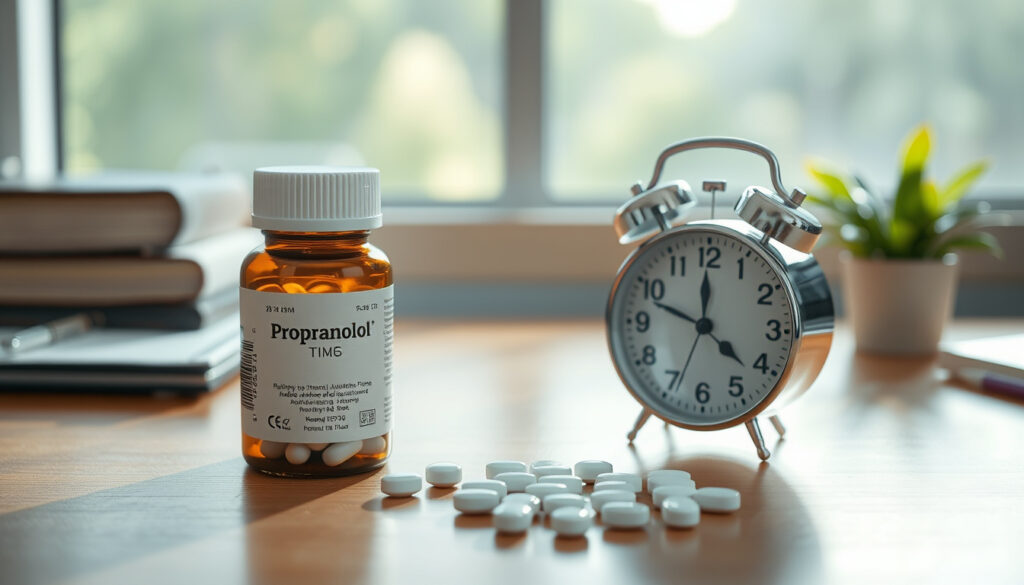
How Quickly Doe Propranolol Work for Anxiety? On et & Do age
Few things throw a spotlight on your nerves like a looming presentation, a job interview, or a social event you can’t escape. If you’ve ever wished you could press a mute button on your racing heart and shaky hands, you’ve probably wondered about propranolol.
Onset of action: 30–60 minutes for immediate‑release propranolol ·
Duration of effect: 3–4 hours for standard doses (10–40 mg) ·
Common starting dose for anxiety: 10 mg twice daily, adjusted by clinician ·
Prescription status: Prescription‑only in the UK and US
Quick snapshot
- Propranolol reduces physical anxiety symptoms within 30–60 minutes (NHS (UK medicines regulator)).
- It is non‑addictive and safe for long‑term use under medical supervision (GoodRx (pharmacy comparison site)).
- Dose must be individualised; 10 mg is a typical starting point (Blossom Health (anxiety treatment platform)).
- Whether it significantly reduces psychological anxiety (worry, fear) compared to placebo (CNTW NHS (primary‑care guidance)).
- The optimal dose for specific anxiety subtypes (e.g., social phobia vs. panic disorder) (GoodRx).
- Peak concentration at about 75 minutes after oral intake (PMC review (peer‑reviewed pharmacology)).
- Effects wear off after 3–4 hours; repeat dosing needed for sustained relief (AmberWillo (public‑speaking resource)).
- Extended‑release versions last up to 12 hours, but onset is slower (Blossom Health).
- NHS advises tapering under supervision when discontinuing (NHS).
Key facts at a glance.
| Drug class | Beta‑blocker (non‑selective) |
|---|---|
| Onset of action | 30–60 minutes (immediate‑release) |
| Duration of effect | 3–4 hours (immediate‑release) |
| Common starting dose | 10 mg twice daily |
| Prescription required | Yes |
How quickly does propranolol work for anxiety?
The short answer: for physical symptoms like a pounding heart, shaking hands, or a sweating brow, propranolol usually kicks in within 30 to 60 minutes after you swallow an immediate‑release tablet. The NHS (UK medicines regulator) notes that the drug is absorbed rapidly, and a 2022 PMC review (peer‑reviewed pharmacology analysis) pegs the peak plasma concentration at about 75 minutes post‑dose. That means the strongest calming effect on your body’s fight‑or‑flight response hits roughly an hour after you take it.
For a person who needs to perform on stage in 90 minutes, a single 10 mg or 20 mg dose taken an hour before gives you a window of physical calm that aligns with the event.
How long does the calming effect last?
Immediate‑release propranolol’s effects on heart rate and tremor begin to fade after about 3–4 hours, according to AmberWillo (a platform for public‑speaking anxiety). This means for a half‑day event, you may need a second dose. Extended‑release formulations, however, can stretch coverage to 12 hours or more, as Blossom Health (anxiety treatment provider) points out — but they take longer to reach peak effect.
Does a higher dose (20 mg) work faster?
Not really. Dose increases the intensity of the effect, not the speed. The same absorption kinetics apply; you still wait roughly half an hour for the first noticeable change. A larger dose may deliver a stronger blockade of adrenaline receptors, but it also raises the risk of side effects like dizziness and fatigue. NHS guidance recommends starting low (10 mg) and titrating based on response.
The implication: if you need fast relief, dose timing matters more than dose size. Take it 45–60 minutes before the stressor arrives.
Is propranolol 10 mg enough for anxiety?
For many people, yes — at least as a starting point. The NHS and Blossom Health both cite 10 mg twice daily as a typical introductory regimen for anxiety. But “enough” depends heavily on the situation and your individual metabolism.
- Mild situational anxiety (e.g., a short presentation): 10 mg single dose often suffices.
- More intense or prolonged events: 20–40 mg per dose may be needed, per AmberWillo.
- Daily use for chronic anxiety: doses are typically higher (up to 120 mg daily) and must be supervised by a doctor, as GoodRx (pharmacy comparison service) emphasises.
Because propranolol is not FDA‑approved for anxiety and is used off‑label, individual GP discretion is wide. No one dose fits all — and the CNTW NHS (primary‑care tip sheet) warns that the drug should not be prescribed for panic disorder.
What factors influence the effective dose?
Body weight, liver function, and the severity of physical symptoms all play a role. People with faster metabolisms may find 10 mg wears off within two hours; those with slower clearance might get five hours from the same dose. The PMC review notes that propranolol’s half‑life is about 3–6 hours in most adults, which explains the broad range of individual responses.
When might a higher dose (40 mg or more) be prescribed?
Clinicians typically consider 40 mg per dose for people who do not get adequate symptom control from 10–20 mg. The maximum daily dose for anxiety is generally 120 mg, but as GoodRx stresses, the dose must be individualised by a doctor. Jumping to high doses carries risks of bradycardia (slow heart rate) and hypotension.
The pattern: start low, go slow, and always link the dose to the specific anxiety trigger.
What this means for you: If you take propranolol for a short event, 10 mg is often enough. For longer or more intense anxiety, you may need 20–40 mg per dose, but always under a doctor’s guidance.
Does propranolol make you feel calmer?
That depends on what you mean by “calm.” Users consistently report that the drug muffles the body’s alarm bells — the racing heart, the shaky voice, the sweaty palms — within the first hour. But does it quiet the worrying mind? The evidence is more cautious.
According to CNTW NHS (primary‑care guidance for anxiety), propranolol “does not treat the underlying anxiety disorder.” It blunts the physical manifestations of adrenaline, so you may feel less ‘on edge’ because your body isn’t screaming danger, but the cognitive loop of worry can remain intact.
A beta‑blocker can make you feel physically composed while your mind still churns. That’s why it’s often paired with psychological strategies — it takes the edge off the body so that cognitive techniques have room to work.
How does propranolol differ from anti‑anxiety medications like Xanax?
The fundamental difference is mechanism. Propranolol is a beta‑blocker that blocks adrenaline receptors on the heart and blood vessels. Xanax (alprazolam) is a benzodiazepine that amplifies the neurotransmitter GABA, directly reducing brain activity — including worry and fear. GoodRx sums it up: propranolol is typically reserved for performance anxiety, while Xanax is FDA‑approved for generalised anxiety disorder and panic disorder. Xanax works faster (15–30 minutes) and lasts about 6 hours, but it carries a well‑documented risk of dependence.
The trade‑off: you trade the psychological control of a benzodiazepine for the safety and non‑addictive profile of a beta‑blocker.
Is propranolol or Xanax better for anxiety?
Neither is universally “better” — the right choice depends on what kind of anxiety you’re dealing with. Below is a head‑to‑head comparison drawn from NHS guidance, GoodRx, and peer‑reviewed pharmacology.
| Attribute | Propranolol (beta‑blocker) | Xanax (alprazolam, benzodiazepine) |
|---|---|---|
| Onset | 30–60 minutes (NHS) | 15–30 minutes (GoodRx) |
| Duration (standard dose) | 3–4 hours (AmberWillo) | About 6 hours (GoodRx) |
| Primary effect | Physical symptoms (racing heart, shaking, sweating) (AmberWillo) | Psychological and physical anxiety (GoodRx) |
| FDA approval for anxiety | No (off‑label) (GoodRx) | Yes — GAD, panic disorder (GoodRx) |
| Addiction risk | Very low (GoodRx) | High (controlled substance) (GoodRx) |
If your primary need is to stop physical symptoms during a specific event — a speech, an exam, an interview — propranolol offers a safe, fast‑acting option with minimal addiction worry. If you suffer from daily, generalised anxiety or panic attacks, Xanax may be more appropriate but carries a steep dependency cost. The CNTW NHS explicitly cautions against using propranolol for panic disorder, reinforcing the importance of matching the drug to the diagnosis.
Upsides
- Non‑addictive — safe for long‑term use under supervision.
- Fast physical relief for performance anxiety.
- No sedation; you stay mentally clear.
- Well‑tolerated by most people at low doses.
Downsides
- Does not address psychological worry or fear.
- Not approved for anxiety in the US; off‑label use requires GP comfort.
- Can cause dizziness, fatigue, and cold hands.
- Short duration may require multiple doses for long events.
How and when to take propranolol?
Timing is everything with this beta‑blocker. The following steps, based on NHS guidance and Blossom Health, outline the practical routine.
- For situational anxiety (e.g., a presentation): Take a single dose 30–60 minutes before the event. The Blossom Health guide suggests 30–90 minutes, but aiming for 60 minutes gives the drug time to peak.
- For daily anxiety control: Propranolol is usually prescribed twice daily — once in the morning and once in the afternoon. Take with or after food to reduce stomach upset, as recommended by the NHS.
- Avoid taking on an empty stomach if you experience nausea. Propranolol can cause gastric irritation, so a light meal helps.
- Do not stop abruptly. The NHS warns that sudden withdrawal can cause rebound hypertension, palpitations, and increased anxiety. Taper under medical supervision.
- Keep a symptom diary. Note the time you take the dose, when you feel relief, and when it wears off. This helps your doctor fine‑tune the dose.
The catch: because propranolol does not treat the cognitive side of anxiety, relying solely on it for daily generalised anxiety may leave the psychological root untreated. The CNTW NHS advises using it as a short‑term adjunct, not a standalone therapy.
Timeline: What to expect after taking propranolol
- 0–30 minutes: Absorption; propranolol enters the bloodstream. Heart rate may begin to slow.
- 30–60 minutes: Onset of physical symptom reduction — you’ll notice less tremor, slower heartbeat, steadier hands.
- 1–2 hours: Peak plasma concentration and maximum effect. This is the sweet spot for a stressful event.
- 3–4 hours: Effects begin to decline. If your event or anxiety lasts longer, a repeat dose may be needed (with your doctor’s guidance).
- 8–12 hours: Extended‑release formulations still provide some coverage, though peak is lower.
The pattern: for a 90‑minute presentation, a single immediate‑release dose taken one hour before gives you full coverage. For a full workday, you’ll likely need a second dose around lunchtime.
What drugs not to mix with propranolol?
Propranolol can interact with several common medications. The NHS advises caution in the following cases.
Common interactions with blood pressure medicines and asthma inhalers
Combining propranolol with other beta‑blockers or calcium‑channel blockers may cause excessive bradycardia (slow heart rate). It can also worsen asthma symptoms when used with certain inhalers. Always inform your doctor about all medications you take.
Alcohol and propranolol: what to know
Alcohol can amplify the blood‑pressure‑lowering effect and worsen dizziness. The NHS advises limiting alcohol while on propranolol.
Do not take propranolol with other heart‑rate‑slowing drugs without medical approval. Use extra caution with diabetes medications, as propranolol may mask signs of low blood sugar.
Confirmed facts vs. What’s still unclear
The evidence on propranolol for anxiety is solid in some areas and thin in others.
Confirmed facts
- Propranolol reduces physical anxiety symptoms within 30–60 minutes (NHS).
- It is non‑addictive and safe for long‑term use under medical supervision (GoodRx).
- Doses must be individualised; 10 mg is a typical starting point (Blossom Health).
- It should not be used for panic disorder (CNTW NHS).
What’s still unclear
- Whether it significantly reduces psychological anxiety (worry, fear) compared to placebo.
- The optimal dose for specific anxiety subtypes (e.g., social phobia vs. panic disorder).
- Long‑term cognitive effects of daily use in younger patients.
Expert and official perspectives
“Propranolol is a medicine used for heart problems, anxiety and migraine. It works by blocking the action of certain natural chemicals in your body that affect your heart and blood vessels.”
— NHS Medicines Information (NHS (UK medicines regulator))
“Propranolol is useful for anticipatory or performance anxiety, but it does not treat the underlying anxiety disorder and should not be prescribed for panic disorder.”
— Dr. Niraj Ahuja, CNTW NHS primary‑care tip sheet (CNTW NHS (NHS trust guidance))
“Propranolol is typically reserved for performance anxiety, whereas Xanax is used more broadly for generalized anxiety disorder and panic disorder. Propranolol is not FDA‑approved for anxiety.”
— GoodRx Editorial Team (GoodRx (pharmacy comparison service))
“Propranolol generally reduces physical symptoms of anxiety such as racing heart and trembling. It usually begins to take effect within 30 to 60 minutes and provides relief for about 3 to 4 hours.”
— AmberWillo (public‑speaking anxiety resource) (AmberWillo)
Bottom line for propranolol users
Propranolol is a fast, non‑addictive tool for turning down the volume on physical anxiety symptoms — exactly what many people need before a high‑stakes moment. But it’s not a mental‑state changer, and the CNTW NHS is clear that it should not replace therapy or other treatments for generalised anxiety or panic. For the person in the UK or US weighing whether to ask their GP about propranolol, the choice is clear: use it for physical symptom control in performance‑type situations, and pair it with psychological strategies if your anxiety runs deeper. Otherwise, Xanax might be the wrong trade‑off — faster effect, but a far heavier price.
For a detailed overview of potential side effects and proper dosing, refer to the common risks and dosage guide for propranolol.
Frequently asked questions
Can propranolol be taken daily for anxiety?
Yes, many people take it twice daily for chronic anxiety. However, it is not a first‑line treatment for generalised anxiety disorder. Always follow your doctor’s dosing schedule.
Does propranolol cause weight gain?
Weight gain is not a common side effect; beta‑blockers are more often linked to fatigue and cold extremities. If you notice significant weight changes, consult your GP.
Can I drink alcohol with propranolol?
Alcohol can amplify the blood‑pressure‑lowering effect and worsen dizziness. The NHS advises limiting alcohol while on propranolol.
Is propranolol addictive?
No. Propranolol does not produce a euphoric “high” and has very low abuse potential, unlike benzodiazepines. However, do not stop abruptly — rebound symptoms can occur.
How does propranolol compare to SSRIs for anxiety?
SSRIs (like sertraline) target the underlying chemical imbalance over weeks, reducing both physical and psychological symptoms. Propranolol works immediately but only on physical symptoms. They are often used together.
What happens if I miss a dose?
Skip the missed dose if it’s close to the next scheduled dose. Never double up. If you miss a dose before a known stressor, take it as soon as you remember, at least 30 minutes before the event.
Can propranolol be used for performance anxiety?
Yes. That is the most common off‑label use. The CNTW NHS tip sheet specifically recommends it for anticipatory or performance anxiety, taken 30–60 minutes beforehand.
More related posts
 Premier League Darts Tickets – 2024 Schedule, Prices and How to Buy
 Barry Ferguson: Rangers legend, trophies, coaching stint
 Hyacinth Bucket Actress Dies at 96: Legacy & Quotes
 One Battle After Another Showtimes: Dublin, Galway, Cork & More
 Cast of Minions (Film) – Who Voices Every Character?
 Serum Alkaline Phosphatase Level: High, Low, Normal Range
 Robert Hardy: Death, Cause of Death & Iconic Roles
 Dean Huijsen: Transfer, Career & Why He Plays for Spain