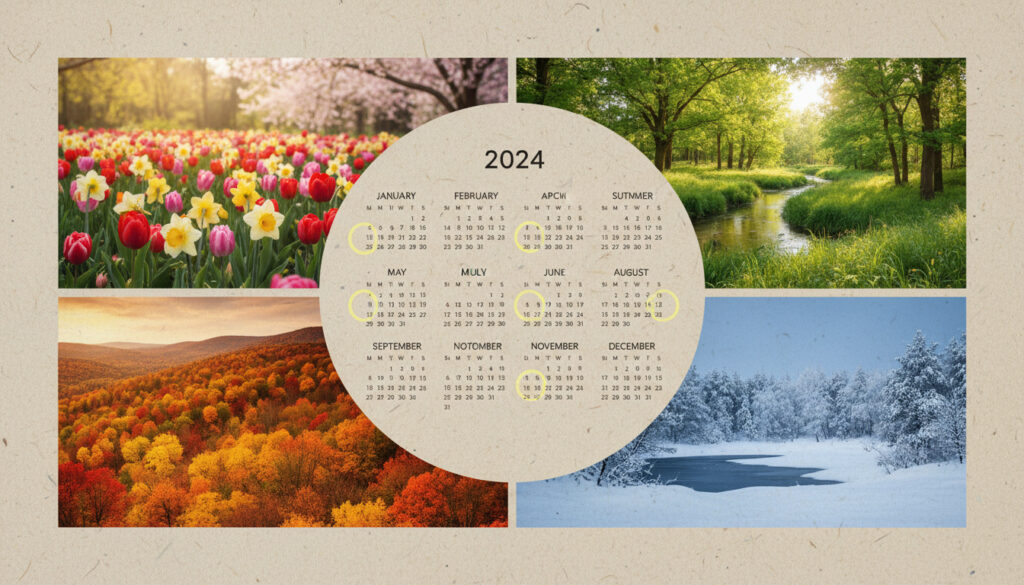
What Season Are We In – 2024 Dates and Definitions
As the Earth completes its annual orbit, the Northern Hemisphere currently experiences autumn, the astronomical season that began with the autumnal equinox on September 22, 2024. This transitional period, characterized by diminishing daylight hours and cooling temperatures, will continue until the winter solstice arrives on December 21.
Determining the current season requires understanding two distinct measurement systems. Astronomical seasons follow Earth’s position relative to the sun, while meteorological seasons align with fixed calendar months to facilitate consistent climate data analysis.
What Season Is It Right Now?
- Seasons vary by hemisphere and definition
- Meteorological seasons use fixed calendar months
- Astronomical seasons track Earth’s 23.5° axial tilt and orbit
- Northern and Southern Hemispheres experience opposite seasons simultaneously
- Equinoxes produce nearly equal day and night worldwide
- Solstices mark the maximum tilt toward or away from the sun
- Exact dates shift annually due to Earth’s elliptical orbit and leap year cycles
| Season | Astronomical Dates (Northern Hemisphere) | Meteorological Dates |
|---|---|---|
| Spring | Mar 20 – Jun 20 | Mar 1 – May 31 |
| Summer | Jun 20 – Sep 22 | Jun 1 – Aug 31 |
| Fall/Autumn | Sep 22 – Dec 21 | Sep 1 – Nov 30 |
| Winter | Dec 21 – Mar 20 | Dec 1 – Feb 28 |
What Are the Four Seasons?
The annual cycle divides into four distinct periods defined by consistent patterns of daylight, temperature, and ecological change. Each season spans approximately three months, though exact timing differs between astronomical and meteorological definitions.
Spring (Vernal)
Spring begins when the sun crosses the celestial equator moving northward, typically around March 20. This vernal equinox triggers budding vegetation and increasing daylight hours. The 2024 vernal equinox occurred at 03:06 UTC on March 20, marking the earliest arrival of spring in 128 years for much of the United States due to the interaction of daylight saving time and the leap year cycle.
Summer
The summer solstice, occurring when the sun reaches its northernmost point above the Tropic of Cancer, initiates the warmest season. In 2024, the Northern Hemisphere summer began on June 20 at 20:51 UTC, lasting 92 days, 17 hours, and 45 minutes until the autumnal equinox.
Autumn (Fall)
Autumn commences with the autumnal equinox as the sun crosses the equator heading south. Canada’s National Research Council notes this astronomical event occurred on September 22, 2024, at 12:43 UTC. The season features diminishing daylight and harvest activities across temperate regions.
Winter
Winter arrives with the solstice when the sun stands directly above the Tropic of Capricorn. The 2024 winter solstice falls on December 21 at 09:20 UTC, representing the shortest day and longest night of the year in the Northern Hemisphere.
“Fall” and “autumn” refer to the same season between summer and winter. While “autumn” appears in scientific and astronomical contexts, “fall” derives from the phrase “fall of the leaf” and remains common in North American English.
When Do Seasons Start and End?
Precise seasonal boundaries depend on whether you follow astronomical events or meteorological calendars. Astronomical dates shift slightly annually, while meteorological dates remain fixed for data consistency.
Astronomical Boundaries
Astronomical seasons begin at solstices and equinoxes determined by Earth’s 23.5-degree axial tilt. The National Weather Service explains these celestial markers align with the sun’s apparent position relative to the equator. Because Earth’s orbit is elliptical rather than circular, the duration between these events varies: summer 2024 spans 92 days 17 hours, autumn lasts 93 days 15 hours 52 minutes, and winter extends 89 days 20 hours 37 minutes.
Meteorological Boundaries
Meteorologists divide seasons into three-month periods corresponding to temperature cycles. This system places winter from December 1 through February 28, capturing the coldest months for statistical analysis. Spring covers March through May, summer encompasses June through August, and fall includes September through November.
Astronomical seasons vary in length because Earth moves faster in its orbit when closer to the sun (January) and slower when farther away (July). This orbital mechanics quirk means Northern Hemisphere winters are shorter than summers by approximately four days.
Astronomical vs. Meteorological Seasons
Two distinct frameworks define seasonal transitions, serving different purposes for scientists, climatologists, and the general public. Understanding their divergence clarifies why weather forecasts and astronomical calendars occasionally conflict.
How Astronomical Seasons Work
Astronomical seasons derive from Earth’s axial tilt and orbit around the sun. When the North Pole tilts toward the sun, the Northern Hemisphere experiences summer; when tilted away, winter arrives. Equinoxes occur when the tilt is perpendicular to the sun’s rays, creating nearly equal day and night globally. The US Naval Observatory provides precise computational data for these events years in advance.
The Meteorological Approach
Meteorological seasons prioritize temperature consistency and statistical analysis. By anchoring seasons to calendar months, climatologists can compare weather data across years without astronomical variability. NOAA utilizes this system for climate monitoring and seasonal forecasting, enabling consistent agricultural planning and energy demand modeling.
Hemisphere Differences
Seasons operate in opposition between hemispheres. When the Northern Hemisphere celebrates the Rugby Autumn Internationals 2025 in cooling temperatures, the Southern Hemisphere enters spring. This reversal occurs because the same axial tilt that exposes one pole to sunlight simultaneously distances the other. Australians experience Christmas during summer, while Canadians observe the holiday in winter.
Distance from the sun does not cause seasons. Earth actually reaches perihelion (closest approach to the sun) in early January during Northern Hemisphere winter. The 23.5-degree axial tilt, not orbital distance, drives seasonal temperature changes.
For 2026, the vernal equinox will occur on March 20 at 14:45 UTC, with the summer solstice following on June 21 at 08:24 UTC. These dates shift gradually due to the precession of Earth’s orbit and the Gregorian calendar’s leap year adjustments.
The Annual Cycle of Seasons
The 2024 astronomical calendar reveals precise moments when seasons transition, calculated to the minute based on Earth’s orientation toward the sun.
- March 20, 03:06 UTC: Vernal Equinox marks the beginning of astronomical spring in the Northern Hemisphere.
- June 20, 20:51 UTC: Summer Solstice initiates the longest day of the year as the sun reaches its northernmost extent.
- September 22, 12:43 UTC: Autumnal Equinox signals the start of fall, with the sun crossing the equator moving southward.
- December 21, 09:20 UTC: Winter Solstice brings the shortest day and official start of winter.
Established Facts vs. Local Variations
While astronomical dates provide universal markers, local experiences of seasons vary significantly based on geography and climate patterns.
| Established Information | Information That Varies |
|---|---|
| Astronomical season dates for 2024 are fixed by Earth’s orbit and axial tilt | Local weather patterns may delay or advance perceived seasonal changes |
| Equinoxes produce nearly equal day and night (12 hours each, adjusted for refraction) | Atmospheric conditions affect exact sunrise/sunset times at specific locations |
| Meteorological seasons follow fixed calendar months | Regional climate zones experience temperature shifts on different schedules |
| Hemispheres experience opposite seasons simultaneously | Microclimates and elevation create exceptions to broad seasonal definitions |
The Science Behind Seasonal Change
Earth’s 23.5-degree axial tilt remains the primary driver of seasonal variation. As the planet orbits the sun, this constant orientation means different hemispheres receive varying intensities of solar radiation throughout the year. When the Northern Hemisphere tilts toward the sun, solar rays strike more directly, concentrating energy over smaller surface areas and creating summer conditions.
The elliptical shape of Earth’s orbit contributes minor variations in distance, but this effect remains secondary to axial tilt. NASA scientists confirm that if orbital distance caused seasons, both hemispheres would experience summer simultaneously, contrary to observed phenomena. The concept of measuring 168 cm in Feet illustrates how precise measurement standards apply across scientific disciplines including astronomy.
Data Sources and Authority
Seasonal calculations rely on precise astronomical observations from multiple international agencies. These institutions provide the foundational data for civil calendars, agricultural planning, and climate research.
Astronomical seasons are based on the position of Earth in relation to the sun, whereas meteorological seasons are based on the annual temperature cycle.
— National Research Council Canada
The dates of the equinoxes and solstices can vary by a day or two each year because of the way the Earth’s orbit and the Gregorian calendar interact.
— US Naval Observatory
Current Season Summary
As of late 2024, the Northern Hemisphere experiences autumn, defined astronomically from the September 22 equinox until the December 21 solstice. Whether tracking astronomical events or meteorological months, understanding these cycles helps explain the rhythmic changes in daylight and temperature that govern natural and human activity across the planet. For specific seasonal sporting events, see the Rugby Autumn Internationals 2025 schedule.
Frequently Asked Questions
What season is it right now in the Northern Hemisphere?
Currently, the Northern Hemisphere experiences autumn (fall), which began on September 22, 2024, with the autumnal equinox and continues until the winter solstice on December 21, 2024.
When does fall start?
Astronomical fall begins with the autumnal equinox, which occurred on September 22, 2024, at 12:43 UTC. Meteorological fall always starts on September 1.
What is the difference between fall and autumn?
There is no difference; both terms describe the season between summer and winter. “Autumn” derives from Latin and appears in scientific contexts, while “fall” is common in North American English.
Why do seasons start on different dates each year?
Astronomical season dates vary because Earth’s orbit is not perfectly circular and the Gregorian calendar does not align precisely with the tropical year. Leap years help correct this drift.
Is October considered fall or winter?
October falls entirely within autumn in both astronomical and meteorological systems. Astronomical autumn runs September 22–December 21, while meteorological autumn spans September 1–November 30.
What season is it in Australia right now?
Australia experiences opposite seasons to the Northern Hemisphere. When it is autumn in the north, Australia enters spring, which began September 22, 2024.
How long do astronomical seasons last?
Astronomical seasons vary in length due to Earth’s elliptical orbit. In 2024, spring lasted 92 days 17 hours, summer 93 days 15 hours 52 minutes, and winter will last 89 days 20 hours 37 minutes.
More related posts
 Arsenal vs Kairat Almaty Standings: Match Result & UCL Table
 What Is an IPO? Initial Public Offering Guide for Investors
 Olivia Colman: Biography, Net Worth, Children, Career Facts
 How Much Is It Worth – Complete Guide to Valuing Antiques
 Birmingham vs Sheffield United: preview, how to watch, H2H facts
 The Fall (TV Series) – Gripping Thriller Breakdown
 Russell Kane: Bio, Career, Wife, EDS, and Why He Changed His Name
 Graham Greene (Actor) – Biography, Career Highlights and Facts