Sir Harold Hillier Gardens: History, Visits & Info
If you’ve never heard of Sir Harold Hillier Gardens, you’re missing one of southern England’s most remarkable green spaces. Tucked away in the Hampshire countryside near Romsey, this 180-acre arboretum holds over 42,000 trees and shrubs from around the world. Whether you’re a gardening enthusiast or just looking for a peaceful day out, there’s a surprising amount to discover here.
Size: 180 acres · Plants: 42,000+ · Champion trees: 611 · National Collections: 14 · Postcode: SO51 0QA
Quick snapshot
- 180-acre arboretum established in 1953 (Visit Hampshire)
- Gifted to the public by Hampshire County Council in 1977 (Visit Hampshire)
- Houses 611 Champion Trees — the UK’s largest collection (TripAdvisor)
- Exact afternoon tea availability — check current offerings on arrival
- Whether seasonal events require advance booking beyond standard tickets
- Current conditions of specific walking trails after recent weather
- Adult tickets: £14.30 (Hampshire Attractions)
- Opening varies by season: 9:30am to 4pm in winter, 10am to 6pm in summer (Hampshire Attractions)
- Located at Jermyns Lane, Ampfield, Hampshire SO51 0QA (Hampshire Attractions)
- Registered assistance dogs only — no other pets allowed
- All-ability paths throughout; wheelchairs available to borrow
- Tea room and café on site, subject to availability
The key facts table below consolidates the essential visitor details referenced throughout this guide.
| Detail | Information |
|---|---|
| Location | Ampfield, near Romsey, Hampshire |
| Size | 180 acres |
| Plants | 42,000 trees and shrubs |
| Postcode | SO51 0QA |
| Founded | 1953 by Sir Harold Hillier |
| Champion trees | 611 |
| National Collections | 14 |
| Opening (summer) | 10am–6pm (1 April to 31 October) |
| Opening (winter) | Varies; 9:30am–4pm peak winter |
| Adult ticket | £14.30 |
| Registered charity | No. 274737 |
What is the history of Harold Hillier Gardens?
Sir Harold Hillier Gardens traces its origins to 1953, when the distinguished plantsman Sir Harold Hillier began developing his personal arboretum on land in Ampfield, just outside Romsey in Hampshire. Hillier was already well known as the founder of Hillier Nurseries, one of Britain’s most respected commercial plant suppliers, and his ambition went far beyond retail: he wanted to build something that would matter to horticulture for generations.
Origins of the arboretum
The site grew steadily over the decades as Hillier acquired specimens from expeditions, fellow collectors, and plant-hunting trips around the world. By the time of his death, the collection had become one of the most important modern plant collections in the world, according to Visit Hampshire. The collection includes an almost unparalleled range of oaks, camellias, magnolias, and rhododendrons, attracting interest from botanists and garden designers alike.
In 1977, Hampshire County Council received the gardens as a gift — a decision that ensured the collection would remain accessible to the public rather than being broken up or sold. Today the gardens operate as a registered charity (No. 274737) and remain publicly owned, maintained with support from admission fees and donations.
The public gift in 1977 transformed what could have been a private estate into a living reference library. Anyone visiting today walks through a collection assembled with deliberate scientific purpose — not simply ornamental display.
Connection to Hillier Nurseries
The connection to Hillier Nurseries runs deeper than shared ownership. The nursery supplied many of the original specimens and continues to propagate rare varieties from the gardens’ stock. Visitors sometimes notice identical cultivars in commercial gardens and at the arboretum — this is by design, not coincidence. The commercial arm helped fund early expansion, and the genetics flow both directions.
Who was Harold Hillier?
Harold Hillier (1905–1985) was born into a family already steeped in the plant trade — the family business, Hillier Nurseries, dated to 1869. Rather than simply running a commercial operation, Hillier developed a scientific passion for woody plants that set him apart from typical nurserymen of his era. He travelled widely, corresponded with collectors globally, and built relationships with institutions including the Royal Horticultural Society.
Early life and career
Raised in Romsey, Hillier took over management of the family nursery at a young age. He expanded it significantly while simultaneously building his private plant collection, acquiring specimens most commercial growers considered too slow-growing or difficult to be worth stocking. His focus on arboreal diversity — trees and shrubs rather than bedding plants — gave his collection a character distinct from typical English horticulture of the period.
Contributions to horticulture
Hillier’s lasting contribution extends beyond the garden’s gates. He helped establish several National Plant Collections — verified groups of closely related cultivars maintained to preserve genetic diversity. The RHS awarded him its Victoria Medal of Honour in recognition of his lifetime of work. His willingness to invest in slow-growing species and unusual provenances gave British horticulture access to a broader plant palette than it might otherwise have had.
Hillier wasn’t chasing trends. He was building insurance for plant diversity at a time when agricultural intensification was already reducing the variety of species in British landscapes. The 14 National Collections at the gardens today are a direct result of that long-term thinking.
What’s special about Sir Harold Hillier Gardens?
What makes this particular arboretum stand out is the scale and intentionality of its plant selection. With 42,000 trees and shrubs representing approximately 12,000 different species from temperate regions worldwide, the gardens function as both a public park and a living conservation database. The Visit Hampshire guide notes the collection is among the most important modern plant collections on earth.
Key collections and trees
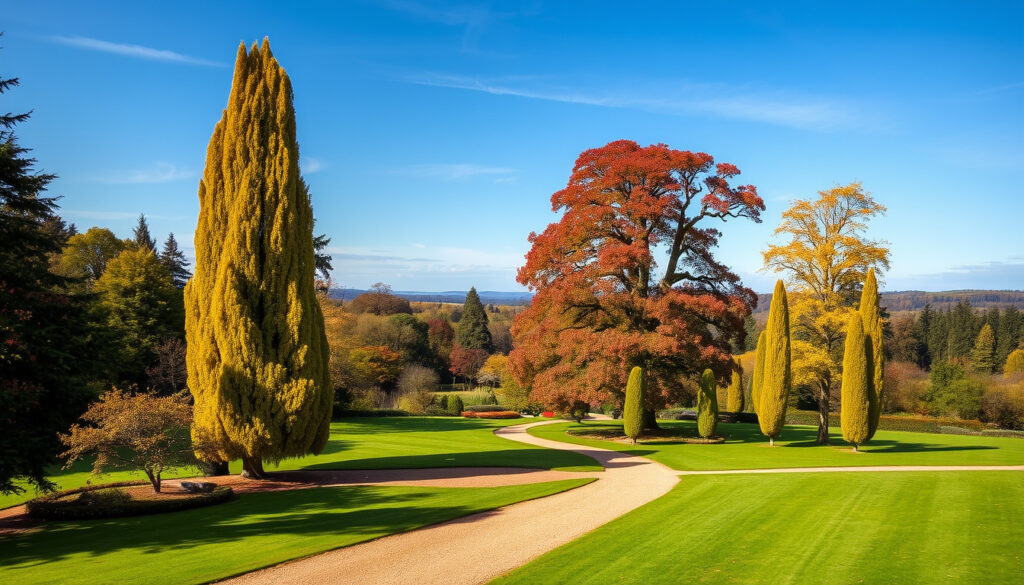
The gardens hold 14 National Collections covering groups such as acers, magnolias, and conifers. The RHS and National Council for the Preservation of Nurseries recognise these collections as verified reservoirs of biodiversity — genetic material that could prove vital if commercial cultivation collapses for any given species. Beyond the scientific value, the visual spectacle is considerable: mature specimens planted decades ago now tower over winding paths, creating a sense of enclosure that contrasts sharply with open farmland nearby.
Spring brings particular intensity. According to Visit Hampshire, the season showcases magnolias, Japanese flowering cherries, azaleas, and rhododendrons in sequence — meaning a single visit in April or May won’t capture everything in bloom. Autumn, meanwhile, brings exceptional bark colour from species selected specifically for winter interest.
Champion trees and the Winter Garden
The gardens contain 611 Champion Trees — the largest such collection in the UK, as documented by TripAdvisor. Champion status is awarded to specimens that are the tallest or largest girth of their species in Britain, making the gardens a kind of hall of fame for exceptional trees.
The four-acre Winter Garden represents a deliberate counterpoint to the common assumption that winter means bare branches. Filled with plants chosen for bold coloured bark and intense scent — witch hazels, sarcococca, and paperbark birches among them — it offers reasons to visit even on short December days, when the gardens close at 4pm. The Visit Hampshire guide ranks it among the largest Winter Gardens in Europe.
How long should I spend at Hillier Gardens?
Most visitors allocate two to three hours, according to TripAdvisor reviews. That estimate covers the main ornamental areas, the Winter Garden, and a coffee stop — essentially the highlighted circuit most visitors follow. Anyone wanting to explore secondary zones, the streamside walks, or the herbaceous and bog gardens will need four hours or more.
Walking routes
The site covers 180 acres across rolling Hampshire countryside. Paths are generally level, and all-ability routes run through the main display areas — a significant advantage for visitors with mobility limitations. Wheelchairs are also available to borrow at the entrance. That said, some secondary paths can become muddy in winter, and sensible footwear is advisable from November through March.
Highlights tour time
A highlights-focused visit — hitting the Champion Tree avenue, the Winter Garden, and the Magnolia beds — can be completed in 90 minutes if you’re moving purposefully. But the gardens reward slower pacing: the scent of a paperbark maple in December sun, or the texture of a 50-year-old hydrangea canopy, takes time to register. Gardeners’ World suggests November to March as the ideal window for focused winter-garden exploration, with fewer visitors and a different character to the landscape.
Last entry closes one hour before the stated closing time. If you’re arriving at 3pm in winter, you may find yourself turned away before you’ve seen the Winter Garden properly — plan for at least 90 minutes of daylight remaining.
Visitor information for Sir Harold Hillier Gardens
Getting practical logistics right matters more here than at most gardens, because the site is large enough that a wrong assumption about parking or entry times can cost hours. The information below draws from Hampshire Attractions and Visit Hampshire, the two most consistent official sources.
Tickets and prices
Standard admission at the time of writing: £14.30 for adults, £4.20 for children aged 5–16, free for children under 5. A family ticket covering two adults and two children costs £33.00. These prices appear on Hampshire Attractions, which manages ticketing on behalf of the charity.
A 2-for-1 winter offer runs from 1 November to 31 March, providing one free entry with each full-paying adult and saving approximately £16.50 per pair, as detailed by Gardeners’ World. The card can be used once per garden per day — it doesn’t allow multiple re-entries on the same visit.
Opening times
Hours shift significantly by season, and confusion here is the most common complaint in visitor reviews. Current schedule according to Hampshire Attractions:
- 1 April to 31 October: 10am–6pm
- 1 November to 19 November: 10am–5pm
- 20 November to 31 December: 9:30am–4pm
- 1 January to 31 March: 10am–5pm
The gardens close on Christmas Day and Boxing Day. Last entry is always one hour before the stated closing time.
Facilities including tea room
The site offers a café, restaurant, and tea rooms within the grounds, though availability varies — particularly during off-peak weekdays when staffing may be reduced. Visitors should treat dining as a pleasant bonus rather than a guaranteed service. Picnic areas are available for those who prefer to bring their own food.
Free parking is available on site, including a limited number of accessible bays. Registered assistance dogs are welcome; no other pets are permitted. All-ability paths cover the main display areas, and wheelchairs can be borrowed free of charge at the entrance.
For drivers, the gardens are signposted from junction 3 of the M27 via the A3057 towards Romsey. From the M3 Winchester direction, exit at junction 11 and follow signs to Hursley and Ampfield. The postcode SO51 0QA works reliably with satellite navigation.
The tea room and café are subject to availability, which means a weekday winter visit could find both closed. If a proper lunch matters to your group, consider eating before arriving or planning a short drive to Romsey — approximately 10 minutes away — where additional options exist.
What visitors and experts say
“The collection of oaks, camellia, magnolia and rhododendron is almost unparalleled, making this one of the most important modern plant collections in the world.”
— Visit Hampshire, tourist information guide
“November to March is the ideal time to explore the arboretum and Winter Garden — the landscape takes on a completely different character, and there are far fewer visitors.”
— Gardeners’ World, garden visit guide
Upsides
- One of Europe’s most significant modern plant collections in 180 acres
- UK’s largest Champion Tree collection (611 trees)
- 14 National Collections with verified preservation status
- All-ability paths and wheelchair loans for accessibility
- Free parking and clear driving directions from M27 and M3
- Winter Garden (4+ acres) with scent-focused winter planting
Downsides
- Opening times change significantly by season — check before visiting
- Tea room and café availability is not guaranteed off-peak
- No pets beyond registered assistance dogs
- Some secondary paths can become muddy in winter months
- Last entry closes 1 hour before stated closing time
Frequently asked questions
What facilities are at Sir Harold Hillier Gardens?
The gardens include a café, restaurant, and tea rooms within the grounds, free parking with accessible bays, wheelchair loans at the entrance, all-ability paths, and picnic areas. Dining facilities are subject to availability, particularly on quieter weekdays.
Is there parking at Sir Harold Hillier Gardens?
Yes. Free on-site parking is available, including a limited number of accessible bays for Blue Badge holders. The car park is adjacent to the main entrance.
Are dogs allowed at Sir Harold Hillier Gardens?
Only registered assistance dogs are permitted within the gardens. No other pets are allowed, even on leads. This policy is strictly enforced to protect the plant collections.
What events happen at Sir Harold Hillier Gardens?
The gardens host seasonal events throughout the year, including guided walks, tree identification sessions, and family activities. Check the official website closer to your visit for the current programme — events often require advance booking beyond standard admission.
How to get to Sir Harold Hillier Gardens from Winchester?
From Winchester, take the M3 southbound to junction 11. Exit and follow signs to Hursley and Ampfield. The gardens are approximately 20–25 minutes from Winchester city centre. The postcode SO51 0QA works well with satellite navigation.
Does Sir Harold Hillier Gardens have wheelchair access?
Yes. All-ability paths run through the main display areas, and wheelchairs are available to borrow free of charge at the entrance. Secondary paths may be less suitable in wet conditions.
What plants can I see at Sir Harold Hillier Gardens?
The gardens hold 42,000 plants from approximately 12,000 temperate species worldwide. Highlights include 611 Champion Trees, 14 National Collections (oaks, magnolias, camellias, conifers, and more), seasonal displays of azaleas, rhododendrons, and Japanese flowering cherries, plus a four-acre Winter Garden with scented bark and winter-flowering species.
For a visitor from Southampton, Winchester, or beyond, Sir Harold Hillier Gardens fills a gap that most regional parks don’t — genuine botanical depth paired with a genuinely relaxing landscape. The entry price of £14.30 represents reasonable value for what’s on offer, and the 2-for-1 winter deal makes an off-season visit particularly attractive. What stops some visitors is the assumption that winter means “nothing to see” — a misreading that misses the Winter Garden entirely. The gardens reward the person who plans around the right season for their interests: spring for rhododendron intensity, summer for shaded walks, autumn for bark colour transition, and winter for scent and solitude. Mottisfont Abbey and Gardens is approximately 20 minutes away by car, making a combined day trip feasible for those willing to plot the logistics in advance. Visitors who take the time to explore thoroughly discover a living library of temperate flora that few other sites in southern England can match.
More related posts
 TUI Discount Code 2024: Save up to £400 on Holidays
 UK House Price Inflation: Latest Data and Analysis
 What Season Are We In – 2024 Dates and Definitions
 Sheffield Wednesday vs Leeds United – Preview, H2H and Prediction
 Serum C-Reactive Protein Level: Normal Range & High Meaning
 How to find out where you are on the NHS waiting list
 Carden Park Spa Day: Prices, Packages & Reviews in Cheshire
 Matt Beard: Hypoxic Brain Injury, Bullying Claims, Inquest