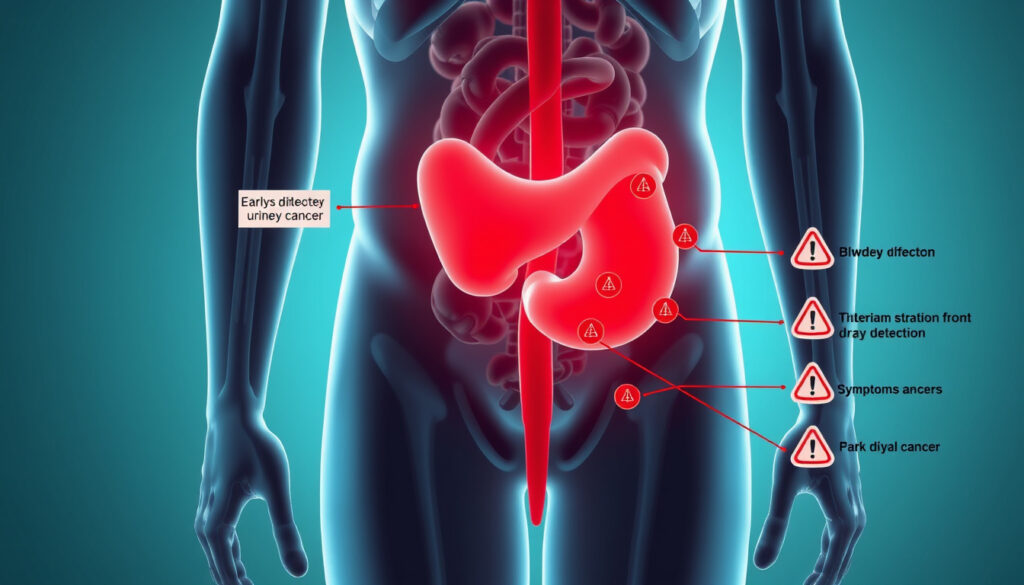
Bladder Cancer Symptoms: Key Warning Signs and Red Flags
Noticing blood in your urine can be alarming, but it’s often shrugged off as a simple urinary tract infection. However, that same sign—especially when painless—is the most common early warning of bladder cancer, a disease that affects thousands each year.
Most common symptom: Blood in urine (hematuria) – occurs in up to 85% of cases ·
Early stage diagnosis: Around 75% of bladder cancers are diagnosed when still confined to the bladder lining ·
Leading risk factor: Smoking contributes to about 50% of bladder cancer cases ·
5-year survival rate (localized): Approximately 77% when caught early
Quick snapshot
- Blood in urine is the most common first sign (Patient Power (patient advocacy resource))
- Smoking causes about half of all cases (Karmanos Cancer Institute (NCI-designated cancer center))
- Early detection dramatically improves survival odds (Memorial Sloan Kettering Cancer Center (leading cancer center))
- Why some people develop bladder cancer symptoms earlier than others (UVA Health (academic medical center))
- Exact biological mechanism behind dietary risk factors (Healthline (health information publisher))
- Why non-smokers still get bladder cancer (Patient Power (patient advocacy resource))
- Symptoms develop gradually over weeks or months, unlike acute UTIs (Healthline (health information publisher))
- Blood in urine may come and go, delaying diagnosis (UVA Health (academic medical center))
- Consult a urologist if blood in urine is persistent (Memorial Sloan Kettering Cancer Center (leading cancer center))
- Urine cytology and cystoscopy are the standard diagnostic tools (Karmanos Cancer Institute (NCI-designated cancer center))
| Fact | Value |
|---|---|
| Most common first symptom | Hematuria (blood in urine) |
| Percentage of cases with hematuria | 80–85% |
| Primary risk factor | Cigarette smoking |
| Typical age at diagnosis | 65–70 years |
| Gender ratio | 4:1 male to female |
A woman who sees blood in her urine after a course of antibiotics and tests negative for infection faces a higher risk of a missed bladder cancer diagnosis — because her symptoms look just like a UTI on paper.
What are the 5 warning signs of bladder cancer?
What is the red flag of bladder cancer?
- Blood in urine (hematuria) — the single most critical warning sign. It’s often painless and can turn urine orange, red, or pink. Microscopic blood may only show up on a lab test (Patient Power (patient advocacy resource)).
- Changes in urination frequency or urgency — a sudden need to go even when the bladder isn’t full (Memorial Sloan Kettering Cancer Center (leading cancer center)).
- Pain or burning during urination — irritation that mimics an infection but doesn’t clear with antibiotics.
- Pelvic pain — ongoing pain in the lower abdomen or back, especially if cancer has spread (Healthline (health information publisher)).
- Unexplained weight loss and fatigue — signs of advanced disease.
Five signals, one pattern: the most reliable red flag is visible or microscopic blood in urine — and it’s the one most commonly dismissed as a harmless UTI. The catch: if that blood is painless, the odds tilt toward cancer, not infection.
A single episode of painless blood in urine should never be ignored. For patients who smoke or have a family history of bladder cancer, the urgency is higher — a urologist’s evaluation can catch this at an early, treatable stage.
What is Stage 1 bladder cancer?
What are the symptoms of stage 1 bladder cancer?
Stage 1 bladder cancer means the tumour is confined to the inner lining of the bladder (classified as Ta or T1) and hasn’t invaded the muscle wall (Karmanos Cancer Institute (NCI-designated cancer center)).
- Symptoms are often minimal — maybe only a trace of blood in urine that comes and goes.
- Some patients report no symptoms at all; the cancer is found incidentally during a urine test for other reasons.
- Treatment typically involves transurethral resection (TURBT) to remove the tumour, followed by surveillance cystoscopy.
The implication: Stage 1 bladder cancer can be silent, which is why anyone with even intermittent hematuria needs diagnostic workup — there’s no way to self-detect a stage 1 tumour at home.
How to rule out bladder cancer at home?
What could be mistaken for bladder cancer?
The short answer: you cannot rule out bladder cancer at home. Home dipstick tests detect blood but can’t distinguish infection from cancer (Healthline (health information publisher)).
Several conditions mimic bladder cancer symptoms:
- Urinary tract infection (UTI) — the most common mimic, also causing burning, frequency, and blood in urine.
- Kidney stones — can cause blood in urine, though usually with severe pain.
- Interstitial cystitis — a chronic bladder condition with frequency and discomfort.
- Benign prostate enlargement — in men, can cause urinary urgency that overlaps with cancer signs.
What tests are used to diagnose bladder cancer?
Only a healthcare professional can provide a definitive diagnosis. The standard steps are:
- Urine cytology — a microscope check for cancer cells in urine (Karmanos Cancer Institute (NCI-designated cancer center)).
- Cystoscopy — a thin camera inserted into the bladder to see the lining.
- Imaging (CT urogram or ultrasound) — to check kidneys and ureters for tumours.
- Biopsy — tissue sample taken during cystoscopy for pathology.
The pattern: Only a healthcare professional can provide a definitive diagnosis, and the standard diagnostic steps are well-established.
What hurts when you have bladder cancer?
What does bladder cancer pain feel like?
- Pain or burning during urination — often described as a stinging sensation, similar to a UTI but not relieved by antibiotics.
- Pelvic pain — a dull ache in the lower abdomen or groin, sometimes constant.
- Lower back pain — can indicate the cancer has spread to the kidneys or bones, especially if one-sided (Healthline (health information publisher)).
- Bone pain — a sign of advanced disease with metastases.
The catch: early bladder cancer often causes no pain at all — the pain comes when the tumour invades deeper or spreads. That’s why painless hematuria is so deceptive.
What causes bladder cancer?
What are the risk factors for bladder cancer?
- Smoking — the dominant cause, accounting for up to 50% of cases. Chemicals in tobacco smoke are filtered through the kidneys and concentrate in the bladder.
- Occupational exposure — aromatic amines used in dyes, rubber, leather, and chemicals increase risk.
- Age and gender — most diagnoses occur between 65–70, and men are about four times more likely than women to develop the disease (UVA Health (academic medical center)).
- Family history — having a first-degree relative with bladder cancer raises risk.
- Chronic bladder inflammation — long-term catheters or infections may increase risk.
The implication: smoking isn’t just a risk — it’s the single biggest actionable cause. For current smokers, quitting reduces risk over time, but the bladder lining retains chemical damage for years.
“Anyone who sees blood in their urine should notify a doctor or urologist immediately — it’s not something to wait and see about.”
— Memorial Sloan Kettering Cancer Center (leading cancer center)
“If blood in the urine is attributed to a UTI, a urine culture should be checked to confirm infection. If the culture is negative or symptoms persist despite antibiotics, a urologist should evaluate.”
— UVA Health (academic medical center)
Being aware of the early warning signs of bladder cancer can be crucial for early diagnosis.
Frequently asked questions
What does the blood in urine look like for bladder cancer?
Blood can turn urine orange, red, or pink if visible. It may also be microscopic — only detectable on a lab test. The bleeding often comes and goes (UVA Health (academic medical center)).
Can bladder cancer cause frequent urination?
Yes — a sudden need to urinate even when the bladder isn’t full is a common symptom, often confused with a UTI.
Is it possible to have bladder cancer without blood in urine?
Rare, but possible. Some patients present with only urinary frequency, urgency, or pain without visible hematuria.
How is bladder cancer diagnosed besides urine tests?
Standard diagnosis uses cystoscopy (a camera inside the bladder) and biopsy. Imaging like CT urogram checks for kidney or ureter tumours (Karmanos Cancer Institute (NCI-designated cancer center)).
Are bladder cancer symptoms different in men and women?
Symptoms are mostly the same — blood in urine, frequency, pain. The difference is how quickly women get diagnosed: they are more likely to be treated for a presumed UTI before being referred to a urologist.
Can bladder cancer cause back pain?
Yes — one-sided lower back pain can occur if the cancer has spread to the kidneys or bones. This is a sign of more advanced disease.
Is bladder cancer curable?
Yes, especially when caught early. The 5-year survival rate for localized bladder cancer (confined to the bladder lining) is about 77%. Late-stage diagnosis dramatically reduces survival odds.
Editor’s note: This article is for educational purposes and does not replace medical advice. If you notice blood in your urine, persistent urinary changes, or pelvic pain, consult a healthcare professional.
More related posts
 Ansel Adams: Biography, Famous Photos, and Lasting Legacy
 Crysencio Summerville: Al-Hilal Transfer & Injury Update
 Serum C-Reactive Protein Level: Normal Range & High Meaning
 Lynn Faulds Wood: Watchdog host’s life, death and legacy
 George Wendt Cause of Death: What Happened to the ‘Cheers’ Star
 Jennifer Love Hewitt: Biography, Age, Kids & Husband
 Louis Walsh: Health, Feuds, and Private Life Exposed
 Chris Eubank Jr: Record, Net Worth, Family & Next Fight