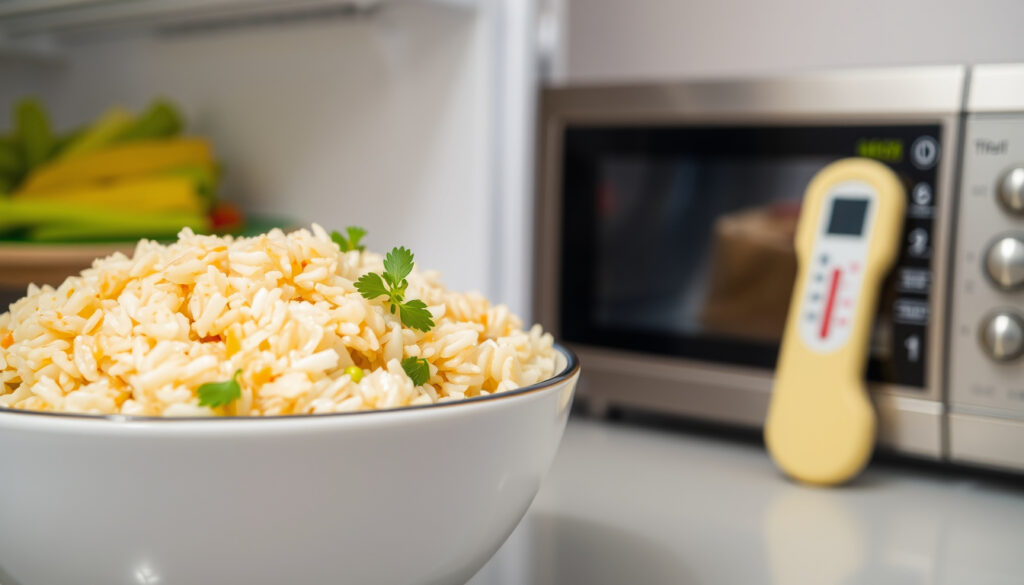
Can You Reheat Rice? Safe Storage Tips and Reheating Methods
Few kitchen questions spark as much debate as whether leftover rice is safe to reheat. The answer is yes—but only if you follow strict time and temperature rules, because cooling speed matters more than reheating itself to avoid Bacillus cereus risk.
Safe reheating temperature: 165°F (74°C) · Refrigerator storage limit: 3 to 4 days · Maximum reheat cycles: 1 · Cooling time before refrigeration: Within 1 hour · Bacillus cereus growth range: 40°F–140°F (4°C–60°C)
Quick snapshot
- Always reheat to 165°F (Medical News Today (health news publication))
- Use a food thermometer (Food Standards Agency (UK food safety regulator))
- Only reheat once (Food Standards Agency) (Medical News Today (health news publication))
- Cool within 1 hour (Food Standards Agency)
- Refrigerate at or below 40°F (Medical News Today)
- Use within 3–4 days (Medical News Today)
- Microwave: add water, cover (RiceSelect (rice producer and retailer))
- Stovetop: steam in covered pan (RiceSelect) (RiceSelect (rice producer and retailer))
- Oven: 300°F, covered (RiceSelect) (RiceSelect (rice producer and retailer))
- Air fryer: low heat, stir (Medical News Today) (RiceSelect (rice producer and retailer))
- Discard if left out >2 hours (Food Standards Agency)
- Throw away if off smell or slime (Medical News Today)
- Never reheat twice (Food Standards Agency)
Five key safety parameters separate a safe leftover from a risky one — the pattern is consistent across health authorities and food producers.
| Parameter | Value |
|---|---|
| Safe reheating temperature | 165°F |
| Max fridge storage | 4 days |
| Max reheat cycles | 1 |
| Cooling time limit | 1 hour |
| Bacteria of concern | Bacillus cereus |
Is it okay to reheat cooked rice?
Proper cooling and storage conditions
- Cooked rice must be cooled quickly — ideally within one hour after cooking (Food Standards Agency).
- Small portions cool faster; divide large batches into shallow containers (Food Standards Agency).
- Refrigerate at or below 40°F (4°C) to slow bacterial growth (Medical News Today).
Safe reheating temperature threshold
- The internal temperature must reach at least 165°F (73.8°C) throughout (Medical News Today).
- Use a food thermometer to verify; color and steam are not reliable (RiceSelect).
- Serve immediately after reheating — do not let it sit out (Medical News Today).
The implication: reheating itself is safe, but the entire chain from cooling to serving determines whether the rice becomes a hazard. The catch is that Bacillus cereus spores survive cooking and only need time in the danger zone to germinate.
When should you not eat reheated rice?
Signs of spoilage
- Off smell, slimy texture, or visible mold — discard immediately (Medical News Today).
- Takeaway rice should be eaten shortly after purchase; handle with extra care (Food Standards Agency).
Storage time limits
- Rice left at room temperature for more than 2 hours must be discarded (Food Standards Agency).
- Refrigerated rice is safe for up to 3–4 days, according to common guidelines (Medical News Today states the same limit).
- The UK Food Standards Agency advises keeping leftover rice in the fridge for no more than one day until reheating (Food Standards Agency).
Why this matters: the window for safe storage is narrow. Most cases of rice-related food poisoning stem from leaving cooked rice too long at room temperature, not from the reheating step itself.
What is the best way to reheat already cooked rice?
Microwave method
- Sprinkle 1 tablespoon of water per cup of rice and cover with a microwave-safe lid or damp paper towel (Dailymotion (media outlet)).
- Heat in 30-second intervals, stirring between each, until steaming hot (RiceSelect).
- Break up clumps to ensure even heating (Medical News Today).
Stovetop method
- Add a splash of water or broth (about 2 tablespoons per cup of rice) to a saucepan (RiceSelect).
- Cover and heat over low to medium-low heat, stirring occasionally, for 3–5 minutes (Medical News Today).
- Fluff with a fork before serving.
Oven method
- Spread rice in a baking dish, add a few tablespoons of water, and cover tightly with foil (RiceSelect).
- Bake at 300°F (150°C) for 15–20 minutes (if refrigerated) or up to 45 minutes (if frozen) (RiceSelect).
- Check internal temperature reaches 165°F.
Air fryer method
- Preheat air fryer to 300°F (150°C). Spray basket with oil to prevent sticking.
- Spread rice in an even layer and cook for 3–5 minutes, shaking halfway (Medical News Today).
- Add a teaspoon of water if rice appears dry.
Microwave is fastest for single servings but often heats unevenly. Stovetop gives better control. Oven works for large batches but takes longest. Air fryer yields a slightly drier texture — best for fried rice.
The pattern: each method has trade-offs, but all require reaching 165°F internally to be safe.
Why shouldn’t rice be reheated in the microwave?
Uneven heating risk
- Microwaves create hot and cold spots; cold pockets can leave bacteria alive (Medical News Today).
- Stirring and letting the rice rest after microwaving helps distribute heat (Medical News Today).
Spore survival
- The microwave alone does not kill Bacillus cereus spores; only sustained high temperature above 165°F does (Food Standards Agency).
- If cold spots remain, spores can germinate after reheating and produce toxins (Medical News Today).
The pattern: microwave reheating works perfectly fine when you take the extra step of stirring and checking temperature. The risk is not the appliance itself but user assumption that it heats everything equally.
What is the 123 rule for rice?
The 1-2-3 method explained
- 1 hour to cool rice after cooking — divide into small portions (Food Standards Agency).
- 2 days maximum in the refrigerator (though the Food Standards Agency advises 1 day for leftover rice) (Food Standards Agency).
- 3 minutes of reheating at high power (or until steaming hot and 165°F internally) (RiceSelect).
The catch: the “2 days” part is more lenient than the UK regulator’s actual guidance. The safest rule is 1 day in the fridge — anything beyond that raises spore germination risk.
The 123 rule is a handy memory aid, not a substitute for checking actual temperature. Use a thermometer, not a timer, to confirm safety.
The catch: while 2 days is a common guideline, the Food Standards Agency recommends 1 day for maximum safety.
Upsides of Reheating Rice
- Reduces food waste — leftover rice becomes a new meal.
- Cost-effective — one batch can serve multiple days (if stored correctly).
- Convenient — quick reheating methods (microwave, stovetop) under 5 minutes.
- Safe if you follow the cooling and reheating rules (Medical News Today).
Downsides of Reheating Rice
- Risk of food poisoning if cooled or stored improperly (Bacillus cereus).
- Quality loss — reheated rice can be drier or mushier than fresh.
- Only one reheat cycle allowed — no second chances (Food Standards Agency).
- Takeout rice requires immediate action after purchase (Food Standards Agency).
How to Safely Reheat Rice: Step-by-Step
- Cool within 1 hour. Spread cooked rice on a baking sheet or divide into shallow containers. Refrigerate once cooled.
- Store properly. Keep in an airtight container in the fridge at 40°F or below. Use within 3–4 days (or 1 day per Food Standards Agency guidance).
- Choose your method. Microwave, stovetop, oven, or air fryer — each works. Add a little water to restore moisture.
- Heat to 165°F. Check with a food thermometer. Stir thoroughly to eliminate cold spots.
- Serve immediately. Do not leave reheated rice at room temperature. Discard any leftovers from the second serving.
The pattern: safety is not about the reheating technique but about the full timeline from cooking to serving. One mistake — leaving rice out too long — cannot be fixed by high heat.
Confirmed Facts and What’s Unclear
- Confirmed facts
-
- Reheating rice to 165°F kills vegetative bacteria (Medical News Today).
- Spores of Bacillus cereus survive cooking (Food Standards Agency).
- Rice should be cooled within 1 hour (Food Standards Agency).
- Refrigerated rice is safe for 3–4 days (Medical News Today).
- What’s unclear
-
- Whether microwaving alone can eliminate cold spots reliably without user intervention (Medical News Today).
- Optimal reheating time for air fryers varies by model and rice type.
- Oven reheating time may range from 15 to 45 minutes depending on quantity and whether rice was frozen or refrigerated (RiceSelect, medium confidence).
- Best serving size for microwave (single) vs stovetop (couple) vs oven (crowd) lacks formal safety validation (Dailymotion, medium confidence).
Expert Perspectives
Never reheat rice more than once.
Food Standards Agency (UK food safety regulator)
Reheating rice is safe if it was cooled and stored correctly.
Medical News Today (health news publication)
The pattern: both authorities agree on the core principle — cooling management is the decisive factor. The Food Standards Agency’s stricter limit (1 day storage) suggests an extra margin of safety for home cooks.
For anyone who values both convenience and safety, the choice is clear: cool rice within one hour, store it for no more than one day, and reheat it only once — or risk Bacillus cereus growth. A simple extra minute of caution can prevent a miserable food poisoning episode.
Many home cooks wonder about safe rice reheating methods, and safe rice reheating methods provides a thorough explanation of the 123 rule.
Frequently asked questions
Can you reheat rice in an air fryer?
Yes, at 300°F (150°C) for 3–5 minutes, shaking halfway. Add a teaspoon of water if dry. Check temperature reaches 165°F.
How long can you reheat rice after cooking?
If stored properly in the fridge, up to 3–4 days. The Food Standards Agency recommends using within 1 day for best safety.
Can you reheat rice twice?
No. The Food Standards Agency and Medical News Today both state rice should never be reheated more than once.
Is reheating rice in the microwave safe?
Yes, if you stir and let it rest to eliminate cold spots, and verify the internal temperature reaches 165°F.
What happens if you eat reheated rice that was left out?
You risk Bacillus cereus food poisoning — symptoms include vomiting and diarrhea, typically within a few hours.
Does freezing rice make reheating safer?
Freezing stops bacterial growth but does not kill spores. Thawed rice must be reheated to 165°F and eaten immediately.
How do you reheat rice without drying it out?
Add a small amount of water (1 tablespoon per cup) before reheating, and cover the container to trap steam.
More related posts
 Tottenham vs Doncaster Rovers Lineups: Confirmed Starting XI
 UK House Price Inflation: Latest Data and Analysis
 Therica Wilson-Read – Unverified Fraud Claims Examined
 Aldi Recalls Gyoza Product – What Shoppers Need to Know
 Borders and Southern Share Price: Forecast, Outlook & Risks (BOR)
 North Face Puffer Jacket: Best Women’s Deals Ireland
 Lucknow Super Giants vs Rajasthan Royals Match Scorecard IPL 2026