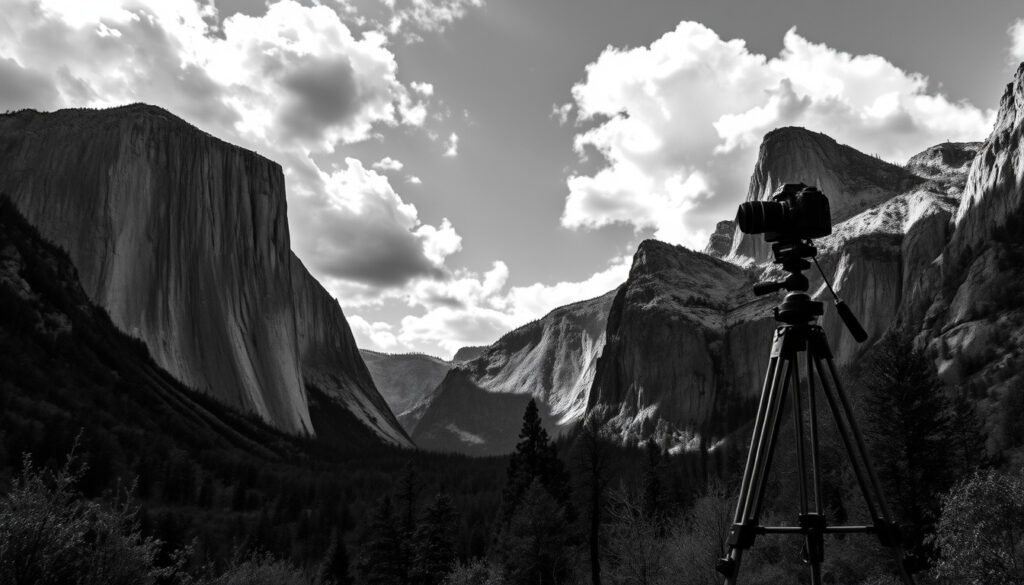
Ansel Adams: Biography, Famous Photos, and Lasting Legacy
There’s a reason photographers still study Ansel Adams decades after his last darkroom session. His black-and-white landscapes of Yosemite and the American West aren’t just beautiful — they’re technical masterpieces that reshaped what photography could achieve. Few artists have balanced artistic precision with environmental activism so effectively, leaving a legacy that extends far beyond the gallery wall.
Born: February 20, 1902 · Died: April 22, 1984 · Known for: Black-and-white landscape photography, environmental activism · Most famous photo: Moonrise, Hernandez, New Mexico (1941) · Record sale: $4.3 million (2006) · Affiliation: Sierra Club, Group f/64
Quick snapshot
- Ansel Easton Adams born February 20, 1902 in San Francisco (Ansel Adams Gallery)
- Co-founded Group f/64 in 1932 (Wikipedia)
- Received Presidential Medal of Freedom in 1980 (Britannica)
- Exact number of prints made during his lifetime
- Which personal camera he used most frequently (multiple sources vary)
- Date of his first solo exhibition (sources conflict between 1928 and 1937)
- Total number of portfolios published during his lifetime
- 1916 – first visit to Yosemite, a formative experience (Santa Clara University)
- 1941 – Moonrise, Hernandez, New Mexico captured (Britannica)
- 1984 – died in Monterey, California (Wilderness Connect)
- Ansel Adams Gallery continues to sell prints and educate
- Digital restoration of his negatives may yield new insights
- Conservation groups still use his images in advocacy campaigns
Seven key facts sum up the man and his work:
| Attribute | Value |
|---|---|
| Full name | Ansel Easton Adams |
| Born | February 20, 1902, San Francisco, CA |
| Died | April 22, 1984, Monterey, CA |
| Nationality | American |
| Known for | Landscape photography, environmentalism |
| Notable work | Moonrise, Hernandez, New Mexico |
What was Ansel Adams most famous photo?
Moonrise, Hernandez, New Mexico, taken in November 1941, is widely considered Adams’ most iconic image. It shows the moon rising above a small town with a dramatic sky and stark chiaroscuro. The photograph’s tonal range and composition have made it a benchmark of black-and-white landscape photography (Britannica).
The shot was unplanned. Adams famously calculated the exposure by instinct: the moon’s brightness and the dimming foreground required a precise balance. The resulting negative produced prints that consistently fetch six and seven figures at auction. A print sold for $4.3 million in 2006, then a world record for a single photograph (Ansel Adams Gallery).
A spontaneous roadside shot, not a composed studio work, became the most commercially valuable photograph of its era. It proves that technical mastery paired with instinct can produce an enduring cultural artifact.
The implication: Adams’ instinctual shot rewrote the market for fine-art photography, turning a split-second decision into a lasting commercial phenomenon.
What is Ansel Adams best known for?
What made Ansel Adams so famous?
- Black-and-white landscapes of the American West, especially Yosemite National Park (Biography.com)
- Co-founding Group f/64, a collective that championed “pure” photography — sharp focus, full tonal range, no manipulation (Wikipedia)
- Developing the Zone System with Fred Archer in the 1930s, a systematic method for controlling exposure and development to pre-visualize the final print (ProGrade Digital)
- Lifelong environmental activism, including service on the Sierra Club board and lobbying for protected wilderness areas (U.S. National Park Service)
Adams’ fame rests on fusing technical innovation with a deeply felt advocacy for wild places. His images became visual arguments for conservation: if you can see the beauty, you’ll fight to save it. The U.S. Fish and Wildlife Service notes that his photographs are “symbols of wild America” used to rally public support for land protection (U.S. Fish and Wildlife Service).
The implication: Adams’ legacy isn’t just artistic — it’s political. His technique gave his activism credibility, and his activism gave his landscapes purpose.
What photo sold for $4.3 million?
A rare print of Moonrise, Hernandez, New Mexico sold at Sotheby’s in 2006 for $4.3 million, at the time the highest price ever paid for a single photograph. The buyer remains anonymous. The sale cemented Adams’ commercial stature and demonstrated the enduring demand for vintage prints of his work (Ansel Adams Gallery).
The print was among a small number that Adams personally developed and signed. Later reproductions, while still valuable, do not command those sums. The record was broken in 2011 by another photograph, but the Moonrise sale remains a milestone in fine-art photography collecting.
What was Ansel Adams criticized for?
Not everyone embraced Adams’ vision. Critics argue that his work romanticized the American landscape by systematically omitting human presence, indigenous history, and industrial development. His pristine wilderness scenes, they contend, presented a sanitized version of the West that ignored the people who lived and worked there (Britannica).
Some members of the photographic community also questioned his purist stance. Group f/64’s strict rules about sharp focus and straight photography were seen as exclusionary. Later in his career, Adams faced accusations of commercialism — selling posters and calendars that diluted his artistic reputation.
Broad popularity meant broader impact: Adams’ market-friendly prints funded his environmental lobbying. The criticism is real, but so is the conservation result — tens of millions of acres protected, partly because his photographs made the wilderness feel worth saving.
The pattern: Adams’ commercial success, while controversial, directly enabled his political influence, creating a feedback loop between art and advocacy.
What was Ansel Adams famous quote?
Two quotes capture Adams’ philosophy. “You don’t take a photograph, you make it” emphasizes the active, intentional craft of photography. The second, “A good photograph is knowing where to stand,” speaks to the importance of composition and perspective over technical gadgetry (Ansel Adams Gallery).
These aren’t just aphorisms — they reflect his Zone System and his insistence on pre-visualization. For Adams, making a photograph began before the shutter clicked; it started with understanding light, tonal values, and the story he wanted to tell.
Timeline
1902 — Born in San Francisco. (Ansel Adams Gallery)
1916 — First visit to Yosemite National Park. (Santa Clara University)
1927 — Published first portfolio, Parmelian Prints of the High Sierras. (Ansel Adams Gallery)
1932 — Co-founded Group f/64. (Wikipedia)
1937 — First solo exhibition at the Yosemite Museum. (Wikipedia)
1941 — Photographed Moonrise, Hernandez, New Mexico. (Britannica)
1955 — Named honorary vice president of the Sierra Club. (Santa Clara University)
1980 — Awarded Presidential Medal of Freedom. (Britannica)
1984 — Died in Monterey, California. (Wilderness Connect)
Clarity: confirmed vs. unclear
Confirmed facts
- Born 1902 in San Francisco, California. (Ansel Adams Gallery)
- Moonrise, Hernandez taken in 1941. (Britannica)
- A print sold for $4.3 million in 2006. (Ansel Adams Gallery)
- Co-founded Group f/64. (Wikipedia)
What’s still unclear
- Exact number of prints made during his lifetime.
- Which personal camera he used most frequently (multiple sources vary).
- Date of his first solo exhibition (sources conflict between 1928 and 1937).
- Total number of portfolios published during his lifetime.
The pattern: While key biographical facts are solid, details of his daily practice and early career milestones remain contested among sources.
Quotes from Ansel Adams
“You don’t take a photograph, you make it.”
— Ansel Adams
Adams also believed that a great photograph fully expresses the photographer’s feelings about the subject, as he stated in his writings (Ansel Adams Gallery).
For photographers today, the lesson is clear: Adams’ success came from merging technical discipline with a deeply held belief in the value of wild places. Ignore either, and you miss the point. For conservationists, the implication is just as direct — if images can move people to protect land, the camera is as powerful as any lobbying tool. The choice for modern practitioners is whether to follow both paths or only one.
Related reading
The pattern: These biographies also examine how personal legacy and public perception intertwine, much like Adams’ story.
anseladams.com, kimhildebrand.com, blog.reallyrightstuff.com
For a deeper look at how his record sales and artistic movement continue to influence the medium, explore Ansel Adams lasting impact on photography.
Frequently asked questions
What camera did Ansel Adams use?
Adams used a variety of large-format cameras including a 8×10-inch view camera and a Hasselblad. He favored cameras that allowed precise control over movements and tonal reproduction.
How did Ansel Adams develop his photos?
He used the Zone System, a method he co-developed, to control exposure and development. He printed his negatives meticulously in his darkroom, dodging and burning to achieve his pre-visualized image.
Was Ansel Adams a member of the Sierra Club?
Yes, he joined in 1919, served on the board, and later became an honorary vice president (Santa Clara University).
What is the Zone System?
A photographic technique developed by Adams and Fred Archer that divides the tonal range into 11 zones, allowing photographers to control exposure and development to achieve a desired print.
Where can I buy authentic Ansel Adams prints?
The Ansel Adams Gallery in Yosemite and online at anseladams.com offer certified prints. Secondary markets like auction houses also sell original vintage prints.
How many photographs did Ansel Adams take?
Adams’ archive includes approximately 20,000 negatives, though the exact number of finished prints is unknown.
Did Ansel Adams work in color?
Yes, he photographed in color for commercial assignments and personal projects, but his fine-art legacy rests almost entirely on his black-and-white work.
More related posts
 Carabao Cup Final Tickets 2026: Prices, How to Buy & Resale
 One Battle After Another Showtimes: Dublin, Galway, Cork & More
 Caravan Storage Near Me: Costs, Rules & Options in Ireland
 Pakistan National Cricket Team: Captains, Squad & Schedule
 I Wanna Dance with Somebody – Lyrics Meaning and Whitney Houston Facts
 Minimum Wage 2026 UK: New £12.71 Rate & Real Living Wage Gap
 Therica Wilson-Read – Unverified Fraud Claims Examined
 Halifax Bank Customer Service: Phone, Chat, Email Guide